The Top 5 Reasons Retirees Run Out of Money — and How to Avoid Them
reasons retirees run out of money, running out of money in retirement, retirement planning, retirement income planning, sequence of returns risk, retirement healthcare costs, long-term care planning, retirement withdrawal strategy, inflation in retirement, how much money do I need to retire
One of the biggest questions facing anyone approaching retirement is: Will my money last for the rest of my life?
Unfortunately, there is no single number or rule that can guarantee a successful retirement. Determining whether your retirement savings will last requires looking beyond how much money you have accumulated. You also need to consider how much you plan to spend, how long you may live, how your money is invested, future healthcare expenses, inflation, taxes, and several other factors that can directly affect the longevity of your retirement assets.
According to Allianz Life’s 2026 Annual Retirement Study, two out of three — or 67% — of those surveyed said they worry more about running out of money than they do about dying.
Research from the Employee Benefit Research Institute (EBRI) has also demonstrated that the risk of exhausting retirement assets isn't limited to lower-income households. EBRI projections cited in the study found:
83% of Baby Boomers in the lowest income quartile could run out of money.
47% of Boomers in the second-lowest quartile could run out of money.
28% of Boomers in the second-highest quartile could run out of money.
Even 13% of Boomers in the highest income quartile could run out of money.
The lesson is important: A high income or large portfolio does not automatically guarantee a successful retirement.
After nearly three decades of working as a financial advisor, I have seen several recurring risks that can put otherwise well-prepared retirement plans in jeopardy. In this article, we'll examine five of the most common reasons retirees run out of money and, more importantly, what you can do to better prepare for each of them.

1.Healthcare and Long-Term Care Costs
One of the biggest expenses retirees can underestimate is healthcare.
For much of their careers, many retirees have had access to relatively affordable healthcare coverage through an employer-sponsored plan. Once you retire, however, the way you pay for healthcare can change dramatically.
The challenge can be especially significant if you retire before becoming eligible for Medicare at age 65.
ACA Subsidy Management for Early Retirees
If you retire before age 65 and purchase health insurance through the Affordable Care Act marketplace, carefully managing your taxable income can become an important part of your retirement income strategy.
For 2026, the enhanced ACA premium tax credits that were available from 2021 through 2025 have expired. As a result, the 400% Federal Poverty Level threshold once again becomes particularly important when determining eligibility for premium tax credits (click here to learn about ACA Subsidies in 2026).
For reference, the 2026 income limits are:
1-person household: $63,840
2-person household: $84,600
3-person household: $106,600
4-person household: $128,600
Note: household members must be claimed as dependents on your tax return to qualify for the increased ACA Subsidy income limit.
This creates an additional consideration for early retirees because distributions from traditional IRAs and 401(k)s, realized capital gains, interest, dividends, and other sources of income can potentially increase the Modified Adjusted Gross Income used to determine ACA subsidy eligibility.
An unexpected increase in income could therefore result in substantially higher healthcare premiums.
This does not make early retirement impossible. It simply makes retirement income planning much more important.
You need to understand not only how much money you will withdraw from your portfolio, but also which accounts those withdrawals should come from.
For a more detailed discussion, click here to read:“What’s the Best Order to Withdraw from Retirement Accounts?”
Medicare and IRMAA
Healthcare planning does not end once you become eligible for Medicare.
One common misconception is that Medicare is free. While most people do not pay a premium for Medicare Part A, Medicare Part B carries a monthly premium, and retirees may also incur costs for Part D prescription drug coverage, supplemental insurance, Medicare Advantage plans, deductibles, copays, and other out-of-pocket expenses.
Higher-income retirees can also be subject to the Income-Related Monthly Adjustment Amount, or IRMAA.
IRMAA is an additional amount added to Medicare Part B and Part D premiums when your Modified Adjusted Gross Income exceeds certain thresholds.
Another important detail is that Medicare generally uses your income from two years earlier to determine whether IRMAA applies.
For example, your 2024 income is generally used to determine your 2026 Medicare IRMAA premiums.
This creates another reason why tax and income planning should begin before you retire.
Large Roth conversions, capital gains, retirement account distributions, or other taxable income can potentially push a retiree into a higher IRMAA bracket and increase Medicare costs two years later.
For a deeper dive into Medicare planning:
Click here to read: Part A,B,C,D costs & Enrollment Timing
Click here to read: Understanding IRMAA and Changes to Medicare in 2026
Don't Forget About Long-Term Care
Beyond traditional healthcare expenses, retirees also need to consider the possibility of needing long-term care.
As we age, we may eventually require assistance completing normal day-to-day activities. In some cases, that assistance can be provided by a spouse or family member. In others, professional care may become necessary.
That could include:
An in-home caregiver
Assisted living
Memory care
A skilled nursing facility
A private nursing home room
These services can become extremely expensive, and Medicare generally does not cover ongoing custodial long-term care.
For example, in Connecticut, the figures used in our planning example estimate median annual costs of approximately:
Non-medical in-home caregiver: $84,656
Assisted living community: $122,361
Private nursing home room: $189,800
Now consider what happens when those costs are compounded by inflation.
For someone who is 60 today and needs long-term care at age 85, assuming 3% annual inflation, those same annual expenses could grow to approximately:
Non-medical caregiver: $182,568
Assisted living community: $263,883
Private nursing home room: $409,321
That can present an enormous risk to a retirement portfolio.
Imagine John and Sarah are both 85 years old. Sarah is relatively healthy and has a family history of women living well into their 90s and early 100s. John's health, unfortunately, deteriorates and he requires a private nursing facility for three years before passing away at age 88.
At a projected annual cost of roughly $409,000, three years of John's care could consume approximately $1.22 million of their retirement savings.
The financial concern isn't limited to paying for John's care. Sarah may still have another decade or more of retirement ahead of her and will continue relying on the remaining portfolio to fund her own expenses.
How Can You Prepare for Long-Term Care?
There are several ways retirees can prepare for this risk.
Some purchase long-term care insurance to transfer a portion of the financial risk to an insurance company. Others determine through retirement projections that they have sufficient assets to self-insure.
Depending on the situation, retirees may also work with a financial advisor and qualified estate planning or elder-law attorney to understand how long-term care expenses could affect their estate and what other planning options may be available.
The important thing is to address the possibility before care is needed.
Waiting until a spouse requires long-term care can dramatically reduce the number of planning options available.

Click here to get your FREE electronic copy of: Fiduciary - How to Find, Hire, and Establish an Aligned Trusted Partnership with a Fee-Only Financial Advisor
2.Aggressive Early Retirement Spending
The second major reason retirees can run out of money is relatively straightforward: they spend too much, too early.
Imagine you've spent 30 or 40 years working, saving, and delaying gratification.
You finally retire.
Naturally, you want to enjoy the money you've worked your entire life to accumulate. You may want to travel, purchase a second home, help your children, buy a boat, renovate your house, or simply enjoy having more free time.
There is nothing inherently wrong with spending more during the early years of retirement.
In fact, retirement spending often isn't linear.
Many retirees experience what are sometimes described as the “go-go, slow-go, and no-go” years.
During the early “go-go” years, retirees may travel extensively, pursue hobbies, dine out frequently, and generally spend more money because they're healthy enough to enjoy those activities.
As they age, travel and discretionary spending may naturally decline.
That means being overly conservative with spending can also be a mistake. Some retirees spend decades worrying about running out of money only to leave behind a much larger portfolio than they ever intended.
The challenge is finding the balance.
How Much Can You Safely Spend in Retirement?
There is an ongoing debate among financial professionals regarding the appropriate withdrawal rate for retirees.
You've probably heard of the 4% rule, which generally suggests beginning retirement by withdrawing approximately 4% of your portfolio and adjusting future withdrawals for inflation.
But retirement isn't one-size-fits-all.
A sustainable withdrawal rate can depend on:
Your retirement age
Portfolio size
Asset allocation
Social Security income
Pension income
Expected longevity
Spending needs
Taxes
Inflation
Market performance
Future healthcare expenses
Your desire to leave an inheritance
A retiree with a large pension covering most basic expenses may be able to safely spend differently than someone whose lifestyle is almost entirely dependent on portfolio withdrawals.
Similarly, someone retiring at 55 may need their portfolio to last considerably longer than someone retiring at 70.
Rather than blindly following a predetermined withdrawal percentage, I recommend developing a comprehensive retirement income plan that projects your expected spending throughout retirement.
The objective shouldn't necessarily be to spend as little as possible.
It should be to determine how much you can comfortably spend while maintaining an appropriate probability that your assets will support you for the rest of your life.
For more context, Click here to read: “William Bengen’s Updated 4% Rule: Is 4.7% the New Safe Withdrawal Rate?”
3. Sequence of Returns Risk
One of the most dangerous risks facing new retirees has very little to do with how much they saved.
It has to do with when investment losses occur.
This is known as sequence of returns risk.
Think of retirement like a football field.
During your working years, you're moving down the field toward the end zone by accumulating assets. But once you approach retirement, you're entering what I like to call the retirement red zone—roughly the five years before and five years after retirement.
Your investment strategy during this period can be particularly important.
What Is Sequence of Returns Risk?
Sequence of returns risk is the danger that poor investment returns early in retirement, combined with ongoing portfolio withdrawals, can cause your assets to decline much faster than long-term average returns would otherwise suggest.
The important word is sequence.
Two retirees can earn similar average investment returns over a long period and still experience dramatically different outcomes depending on when the negative years occur.
Here's why.
When the stock market falls and you need $50,000 to fund your living expenses, you may have to sell more shares to generate that $50,000.
Those shares are then permanently removed from your portfolio.
If the market subsequently recovers, you have fewer shares participating in that recovery.
An Example of Sequence of Returns Risk
Let's assume Mike retires at age 60 with a $1 million portfolio.
He plans to withdraw $50,000 during his first year of retirement and increase that withdrawal by 3% each year for inflation.
Now we'll compare two scenarios.
In the first scenario (Portfolio A - Blue line), Mike experiences two consecutive 15% investment losses during years 10 and 11 of retirement.
In the second scenario (Portfolio B - Orange line), everything is identical except those two 15% losses occur during years one and two.
Same starting portfolio. Same withdrawals. Same two market losses. The only difference is when the losses occur.
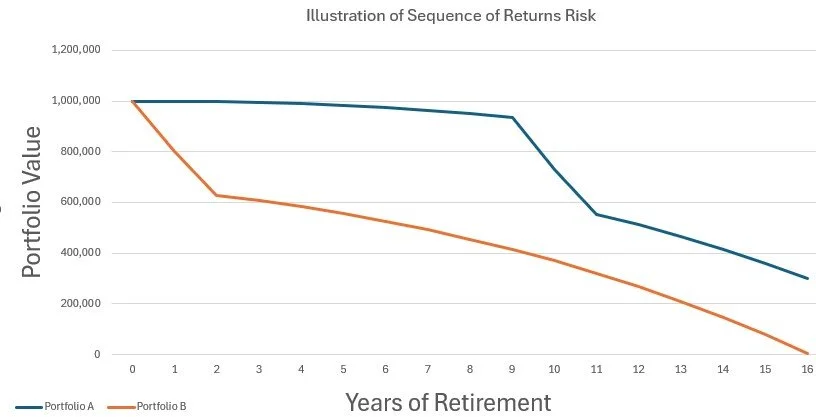
In the projection used for this example, experiencing the losses immediately after retirement results in Mike exhausting his portfolio approximately six years earlier.
That's sequence of returns risk.
How Can Retirees Reduce Sequence of Returns Risk?
One potential strategy is to maintain a portion of the portfolio in cash, money market funds, short-term fixed income, and other relatively low-volatility investments.
The objective is to create a reserve that can potentially fund expenses during periods of significant stock-market declines.
Instead of selling equities after they've fallen substantially, a retiree may be able to temporarily draw from the more conservative portion of the portfolio.
This can give equity investments additional time to recover before they need to be sold.
The appropriate amount to maintain in these reserves will vary significantly from person to person. Holding too little can leave you exposed to market declines, while holding too much in cash or conservative investments can introduce another major retirement risk that we will cover shortly.

4. Family Financial Support
For many retirees, retirement planning isn't only about themselves.
They want to help their children and grandchildren. That could mean helping with college tuition, contributing toward a first home, paying for a wedding, helping a child through financial hardship, or simply providing gifts while they're still alive to see their family enjoy them.
There is nothing wrong with incorporating family support into your retirement plan. In fact, for many of our clients, gifting to children and grandchildren is one of their most important financial goals.
The problem arises when retirees give away more than their financial plan can reasonably support.
Make Sure Your Own Retirement Is Secure First
When it comes to providing financial assistance to family members, I like to use the same analogy you've probably heard when flying on an airplane:
Put on your own oxygen mask before helping someone else.
Before making a substantial gift, you should understand how that gift could affect the longevity of your retirement assets.
For example, assume you're considering giving your child $100,000 to help them purchase their first home.
The financial impact isn't necessarily limited to $100,000.
If that $100,000 would otherwise have remained invested and earned an average annual return of 6%, it could potentially grow to approximately:
$179,000 after 10 years
$321,000 after 20 years
$574,000 after 30 years
Of course, investment returns aren't guaranteed. The point is that when you remove money from your retirement portfolio, you're also giving up the potential future growth of those assets.
That's why substantial gifts should ideally be incorporated into your retirement projections before you write the check.
A financial advisor can model the proposed gift and help you understand how it may affect your future cash flow, portfolio longevity, taxes, and estate.
You may discover that you can comfortably afford the gift.
You may determine that a smaller gift would be more appropriate.
Or you may decide that you'd rather provide the money gradually over several years.
The objective isn't to discourage generosity. It's to make sure you're giving from a position of financial strength.
Be Careful About Becoming the Family Bank
Occasionally, retirees also find themselves providing recurring financial support to adult children or other family members.
One payment may not seem significant. But repeated gifts can eventually become another ongoing retirement expense.
If you're regularly helping a family member with rent, mortgage payments, credit card debt, car payments, childcare, or other expenses, those payments should be included in your retirement budget just like any other recurring expense.
You should also be particularly cautious about co-signing loans or taking on debt for someone else.
Before providing substantial financial assistance, ask yourself an important question:
Can I afford to give this money away without jeopardizing my own retirement?
If the answer isn't clear, that's a sign that some additional planning may be necessary.
5. Inflation
The fifth major risk is one that can quietly erode your retirement plan over decades:
Inflation.
Inflation is particularly dangerous for retirees because retirement can last 20, 30, or even 40 years.
A retirement income that seems more than sufficient at age 65 may not provide nearly the same purchasing power at age 85.
Let's assume you retire needing $100,000 per year to maintain your lifestyle.
If your expenses increase by an average of 3% annually, maintaining that same lifestyle would require approximately:
$134,000 per year after 10 years
$181,000 per year after 20 years
$243,000 per year after 30 years
You're not necessarily living a more expensive lifestyle.
You're simply paying considerably more for the same goods and services.
That's why planning your retirement around today's expenses without accounting for inflation can create a major problem later in life.
Some Retirement Expenses Can Rise Faster Than Others
Another challenge is that inflation doesn't affect every expense equally.
Housing, food, transportation, utilities, insurance, and healthcare costs can all increase at different rates.
Healthcare and long-term care expenses, in particular, can become increasingly important later in retirement.
This is why simply assuming your expenses will remain flat throughout retirement can significantly underestimate how much money you may ultimately need.
Being Too Conservative Can Create Inflation Risk
Inflation also creates an investment challenge.
Many retirees naturally become more conservative when they stop working.
That makes sense.
Once your paycheck disappears and you're relying on your portfolio for income, protecting your savings becomes increasingly important.
However, moving your entire retirement portfolio into cash, CDs, money market funds, or other conservative investments can create a different problem.
Your portfolio still needs enough long-term growth potential to help maintain your purchasing power.
For example, if your investments earn 2% while your expenses increase by 3%, your purchasing power is declining by approximately 1% per year before considering taxes.
Over a 20- or 30-year retirement, that difference can become substantial.
This is why retirement investing is often a balancing act.
You generally want enough conservative assets to cover near-term expenses and help manage market volatility, while maintaining enough exposure to growth-oriented investments to help your portfolio keep pace with inflation over the long term.
The appropriate balance will depend on your individual circumstances, including your age, risk tolerance, income needs, portfolio size, Social Security benefits, pension income, and expected longevity.
Click here to read: 5 Smart Investments to Grow Your Money in 2026
Click here to read: 7 Conservative Investments to Preserve Capital and Earn Steady Returns 2026.
Options to Reduce Your Risk
There is no single strategy that can guarantee you'll never run out of money.
Successful retirement planning requires coordinating several moving pieces.
Your investment strategy affects your withdrawal strategy.
Your withdrawal strategy affects your taxes.
Your income can affect Medicare premiums and healthcare subsidies.
Your spending affects portfolio longevity.
And unexpected healthcare, long-term care, or family expenses can alter a plan that previously appeared perfectly sustainable.
That's why retirement planning should be viewed as an ongoing process rather than a one-time calculation.
As you approach retirement, consider these five questions:
Have I realistically accounted for healthcare and potential long-term care expenses?
Am I withdrawing and spending too much during the early years of retirement?
Is my portfolio positioned to withstand a significant market decline shortly before or after I retire?
Can I afford the financial support I want to provide to children or other family members?
Does my retirement plan account for decades of inflation?
If you cannot confidently answer these questions, it may be worth revisiting your retirement projections before leaving the workforce.

Final Thoughts
Running out of money in retirement usually isn't the result of one isolated mistake. More often, several smaller risks begin to compound. Maybe you retire slightly earlier than anticipated. Healthcare costs more than expected. The stock market declines during your first few years of retirement. You spend heavily on travel while you're healthy. You give your children more financial support than originally planned. Then, 15 or 20 years later, inflation has pushed your everyday living expenses considerably higher. Individually, each of these risks may be manageable. Together, they can significantly alter the trajectory of a retirement plan. This is why I believe one of the most valuable things you can do before retiring is develop a detailed retirement cash-flow projection.
Don't simply ask:
“How much money do I need to retire?”
Instead, ask:
“How will my income, expenses, taxes, investments, healthcare costs, and major financial goals interact throughout the rest of my life?”
A comprehensive financial plan can help you answer that question and identify potential problems while you still have time to address them
“What would I get from a Financial planning engagement?” — (Click here to watch a Sample Financial Planning Engagement).
Retirement should ultimately be about enjoying the assets you've spent decades accumulating—not constantly worrying about whether you're going to run out of money.
Careful planning today can give you greater confidence to actually enjoy those assets tomorrow.
As always have a wonderful day,
a better weekend,
and I look forward to writing to you next Friday!
Written by Ryan Morrissey CFP®, CLU®, CHFC®, CMFC
Founder & Principal Advisor of Morrissey Wealth Management
Host of the Retire with Ryan Podcast
———————————————————————————————————————————————————————————————
Frequently Asked Questions:
What is the biggest risk of running out of money in retirement?
There isn't one risk that applies equally to every retiree. Excessive withdrawals, poor investment returns early in retirement, inflation, healthcare and long-term care expenses, and unexpected spending can all contribute to a retiree exhausting their savings.
A comprehensive retirement projection can help determine which risks are most significant for your individual situation.
How much money do I need to retire?
The amount you need depends largely on your expected expenses and sources of guaranteed or recurring retirement income.
Social Security, pensions, rental income, and other income sources can reduce how much you'll need to withdraw from your investments.
Instead of focusing exclusively on reaching a specific portfolio value, determine how much annual income you'll need and how much of that income your portfolio will be responsible for producing.
Is the 4% rule still appropriate for retirement?
The 4% rule can be a useful starting point, but it shouldn't automatically determine how much every retiree withdraws.
Your appropriate withdrawal rate depends on factors such as your retirement age, portfolio allocation, expected longevity, spending needs, guaranteed income sources, market conditions, and financial goals.
For some retirees, 4% may be sustainable. Others may need to begin with a lower withdrawal rate, while certain retirees may have the flexibility to spend more.
What is sequence of returns risk?
Sequence of returns risk is the possibility that significant investment losses early in retirement, combined with portfolio withdrawals, could cause your assets to be depleted faster.
Even if two retirees experience similar average investment returns over their lifetimes, the retiree who experiences major losses during the first few years of retirement can have a significantly worse outcome.
How can I protect my retirement portfolio from a market crash?
There is no way to completely eliminate investment risk while maintaining the growth potential many retirees need.
One strategy is maintaining an appropriate allocation of cash and lower-volatility investments that can potentially be used to fund expenses during significant market downturns. This may reduce the need to sell stocks after they have declined.
Your appropriate allocation should be based on your personal income needs, risk tolerance, time horizon, and overall retirement plan.
How should I plan for long-term care expenses?
Start by estimating the potential cost of care in your area and modeling how several years of those expenses could affect your retirement portfolio.
Depending on your financial circumstances, you may decide to self-fund the risk, purchase long-term care insurance, use another insurance strategy, or coordinate your financial plan with an elder-law or estate planning strategy.
The important thing is to address the risk while you're healthy rather than waiting until care becomes necessary.
Should retirees keep money invested in stocks?
For many retirees, maintaining some exposure to stocks can provide long-term growth potential and help combat inflation.
However, the appropriate percentage varies substantially from person to person. Your investment allocation should consider your income needs, risk tolerance, time horizon, other income sources, and ability to withstand market volatility.
Retirement doesn't necessarily mean eliminating investment risk. It means managing risk differently.